
Use this Break Even ROAS Calculator to find the minimum ROAS you need to avoid losing money on ads.Break-Even ROAS Calculator
Calculate your exact profitability threshold
Enter values to calculate.
Break Even ROAS Calculator helps you find the minimum return on ad spend needed to avoid losing money on ads.
Running ads without knowing your break-even ROAS is risky. You may see sales coming in, but still lose money after product cost, shipping, payment fees, platform fees, and ad spend.
A Break-Even ROAS Calculator helps you understand the minimum return on ad spend you need before your ad campaign becomes profitable.
ROAS means Return on Ad Spend.
For example, if you spend $100 on ads and generate $300 in revenue, your ROAS is 3x.
But 3x ROAS does not always mean profit. If your product margin is low, shipping cost is high, or discounts reduce your revenue, you may still lose money. That is why break-even ROAS is more important than just normal ROAS.
Recent ecommerce ROAS benchmarks show that many brands operate around the 2x to 4x ROAS range, depending on product category, margin, ad platform, and customer lifetime value. Triple Whale says a “good” ROAS is often around 3 to 4, while its 2024 median ROAS across tracked brands was around 2.04.
Track your ROAS and profit using Triple Whale’s free ecommerce dashboard.
Using this Break Even ROAS Calculator is very simple.
Table of Contents
How to Use This Break-Even ROAS Calculator
First, enter your selling price. This is the amount your customer pays for one product.
Second, enter your cost of goods sold. This means the actual cost of producing or buying the product.
Third, add your shipping cost. If you offer free shipping, still include the cost because you are paying it from your margin.
Fourth, add fees and other costs. This can include payment gateway fees, marketplace fees, packaging cost, transaction fees, or any other per-order cost.
After entering these numbers, the Break Even ROAS Calculator will show your minimum break-even ROAS.
If your actual ROAS is below this number, your campaign is losing money.
If your actual ROAS is above this number, your campaign may be profitable.
Example:
Selling Price: $100
Product Cost: $40
Shipping: $10
Fees: $5
Total cost = $55
Profit before ads = $45
Profit margin = 45%
Break-even ROAS = 2.22x
This means you need at least 2.22x ROAS just to avoid losing money.
Why This Break Even ROAS Calculator Is Useful
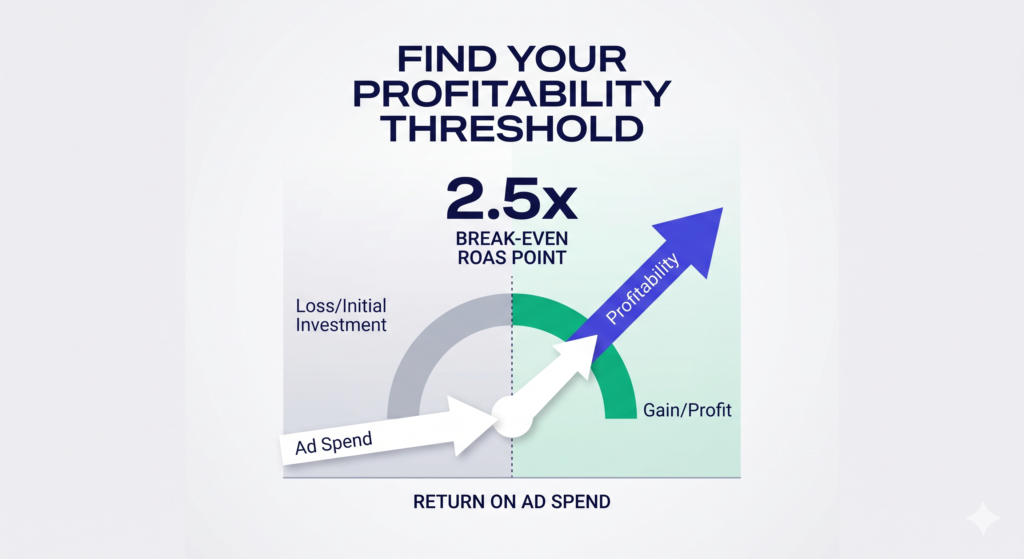
This Break Even ROAS Calculator helps ecommerce sellers, Shopify store owners, Meta advertisers, Google Ads users, Amazon sellers, SaaS marketers, and performance marketing agencies make better ad decisions.
It helps you answer questions like:
Should I increase my ad budget?
Am I actually profitable?
What ROAS should I target?
Can I afford discounts?
Is my product margin too low?
Should I improve pricing before scaling ads?
This is very important because global ecommerce is still growing, but advertising competition is also increasing. Shopify reports ecommerce trends around global selling, digital buying behavior, and cross-border growth, which means more businesses are competing for the same online customer attention.
Break-Even ROAS Formula by Break Even ROAS Calculator
The formula is:
Break-Even ROAS = 1 ÷ Profit Margin
Profit Margin is:
Profit Margin = Net Profit Before Ads ÷ Selling Price
Example:
If your profit margin is 40%, then:
Break-Even ROAS = 1 ÷ 0.40 = 2.5x
That means you need 2.5x ROAS to break even.
If you found this Break Even ROAS Calculator useful, you can also explore our other free business tools.
Frequently Asked Questions About Break-Even ROAS
1. What is a good ROAS?
A good ROAS depends on your business margin. Many marketers talk about 3x or 4x ROAS as good, but this is not always true. If your profit margin is 20%, even 4x ROAS may only be break-even. If your margin is 60%, then 2x ROAS may already be profitable.
Triple Whale mentions that many brands consider 3 to 4 ROAS good, while the median ROAS among brands it tracked was around 2.04 in 2024.
2. Is 2x ROAS profitable?
Not always.
2x ROAS means you earn $2 for every $1 spent on ads. But if your product cost, shipping, fees, and taxes are high, you may still lose money.
For example, if you sell a product for $100 and your total cost before ads is $60, your profit before ads is $40. If you spend $50 on ads to get that $100 sale, your ROAS is 2x, but you are losing $10.
So, 2x ROAS is profitable only if your margin is strong enough.
3. Why is my ROAS high but profit low?
This usually happens because ROAS only looks at revenue and ad spend. It does not include product cost, shipping cost, packaging, refunds, taxes, payment fees, discounts, or agency fees.
That is why many ecommerce owners get confused. Their ad dashboard may show a strong ROAS, but their bank account does not grow.
Break-even ROAS gives a more realistic view.
4. Should shipping cost be included in break-even ROAS?
Yes. If you pay for shipping, you should include it.
Even if you charge the customer for shipping, you should still check whether shipping affects your actual profit. For ecommerce stores offering free shipping, ignoring shipping cost is one of the biggest mistakes.
5. Should discounts be included?
Yes. Discounts reduce your actual selling price.
For example, if your product price is $100 but you give a 20% discount, your real revenue is $80. Your break-even ROAS should be calculated on $80, not $100.
This is especially important during Black Friday, Cyber Monday, festive sales, and clearance campaigns.
6. What is the difference between ROAS and ROI?
ROAS measures revenue generated from ad spend.
ROI measures actual profit compared to investment.
ROAS formula:
Revenue ÷ Ad Spend
ROI formula:
Profit ÷ Investment
ROAS is useful for ad performance, but ROI is better for understanding real business profit.
7. What ROAS should I target for Meta Ads?
For Meta Ads, many ecommerce brands usually aim for around 2.5x to 4x ROAS, but the correct target depends on your margin, product price, and repeat purchase rate. Some 2025 ecommerce benchmark discussions place Meta Ads in that broad range, but you should not copy a benchmark blindly.
Your best target is:
Your break-even ROAS + enough profit margin to scale safely.
8. What ROAS should I target for Google Ads?
Google Ads ROAS depends heavily on search intent. Branded search campaigns may get very high ROAS because people already know your brand. Cold search campaigns may have lower ROAS because users are still comparing options.
Instead of asking only “what is a good ROAS,” ask:
What is my break-even ROAS?
What is my profit after ads?
Which campaign brings repeat customers?
9. Can I scale ads below break-even ROAS?
Usually, no. Scaling below break-even ROAS means you are increasing losses.
But there are exceptions. A business may accept lower first-order ROAS if customers buy again later. This is common in subscription businesses, SaaS, supplements, beauty products, coffee brands, and repeat-purchase ecommerce.
In that case, you should also calculate LTV, not just first-order ROAS.
10. How does customer lifetime value affect ROAS?
Customer lifetime value means the total revenue or profit a customer brings over time.
If a customer buys once, you need to be profitable on the first order.
But if a customer buys every month, you may afford a lower first-order ROAS because future purchases recover the cost.
For example:
First purchase profit: $20
Ad cost: $30
First order loss: $10
But if the customer buys three more times, the campaign may become profitable later.
That is why ecommerce brands should track both break-even ROAS and LTV.
11. Should fixed costs be included?
For a simple break-even ROAS calculator, include only per-order costs like product cost, shipping, and fees.
But for advanced business planning, you should also consider fixed costs like salaries, rent, software, freelancers, agency fees, and warehouse expenses.
If you ignore fixed costs completely, your ads may look profitable but your business may still struggle.
12. Why does Facebook or Google show different ROAS than my actual profit?
Ad platforms usually show attributed revenue, not actual profit.
They may not subtract product cost, shipping, refunds, discounts, taxes, or payment charges. Also, attribution windows can make one platform claim credit for a sale that another channel helped generate.
That is why you should use platform ROAS plus your own calculator.
13. How do refunds affect break-even ROAS?
Refunds reduce your real revenue.
If your refund rate is high, your required ROAS should be higher. For example, if you generate $10,000 in sales but refund $1,000, your actual revenue is $9,000. Your Break Even ROAS Calculator should be based on real retained revenue, not just gross sales.
14. What is blended ROAS?
Blended ROAS means total revenue divided by total ad spend across all platforms.
Formula:
Total Revenue ÷ Total Ad Spend
This is useful because customers often see your brand in multiple places before buying. For example, they may see a Meta ad, search on Google, visit your website, and later buy through email.
Blended ROAS gives a bigger business-level view.
15. What is the biggest mistake people make with ROAS?
The biggest mistake is thinking “high ROAS means high profit”.
This is not always true.
A business with 6x ROAS but very low margin may earn less profit than a business with 3x ROAS and strong margin.
Always check profit, not just revenue.